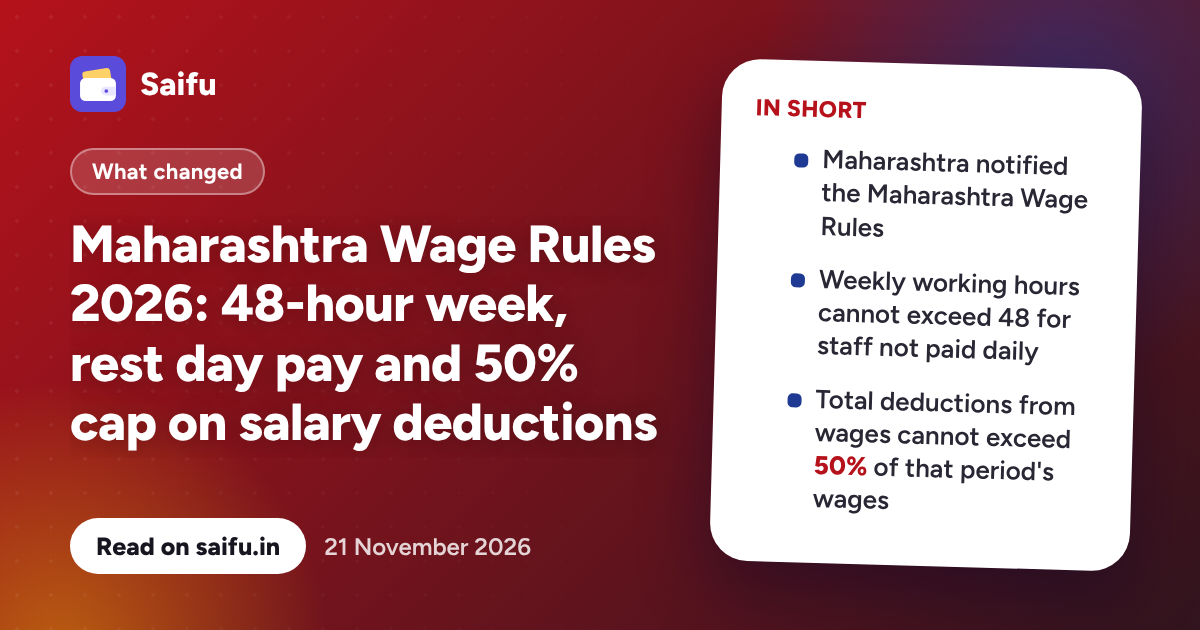
Maharashtra Wage Rules 2026: 48-hour week, rest day pay and 50% cap on salary deductions
Maharashtra notified its Wage Rules on 5 November 2026. What changes for salaried staff on working hours, rest day pay, deductions and wage slips.
Maharashtra has notified the Maharashtra Wage Rules, 2026 under the Code on Wages, 2019. The Labour Department notification is dated 5 November 2026, and the rules came into force on the date they were published in the Official Gazette. News reports on 19 and 20 November brought them to wider notice.
The rules replace the Maharashtra Minimum Wages Rules, 1963 and the Maharashtra Payment of Wages Rules, 1963. Rule 3 says the state will not fix minimum wage rates for Maharashtra government employees under the Code, so that part is not for them. Check with your employer which provisions cover you.
Working hours and rest days
For an employee whose wage period is daily, a normal working day is eight hours. For everyone else, the working hours must be fixed so that the weekly total does not exceed 48 hours (Rule 5).
You must get at least one rest day a week. In a six-day week it is ordinarily Sunday, but the employer can fix another day and must tell you before any change (Rule 6).
You cannot be made to work on a rest day unless you get a substitute full day off on a working day in the week just before or after. No substitution may leave you working more than 10 days in a row without a full day of rest.
Pay for working on a rest day
If you work on a rest day and get a substitute day off, you are paid for the rest day worked at the overtime rate, and the substitute day at the rate of the previous working day.
In the six-day-week cases where the daily wage is worked out by dividing the monthly wage by 26, the rest day worked is paid at the overtime rate, which must not be less than twice the normal rate of wages. This is not a blanket "double pay for every overtime hour", so read the conditions in Rule 6 before assuming it applies to your job.
Cap on deductions
Under Rule 11, total deductions an employer makes from your wages in a wage period cannot exceed 50% of your wages for that period. Any excess is carried forward and recovered in later periods, again within the 50% limit each month.
For a fine or a deduction for damage or loss, the employer must give you a notice and seven days to show cause before deducting.
Other points
- Variable dearness allowance on minimum wages is revised twice a year, before 1 April and before 1 October, using the Consumer Price Index for Industrial Workers.
- Minimum wages are worked out per day. The monthly rate uses 26 days.
- Employers must keep employee, wage, overtime and attendance registers for five years after the last entry.
- A wage slip must be issued on or before the day wages are paid (Rule 41).
What it means for your pay
The rules set a framework. They do not change your salary by themselves. The wage definition in the Code on Wages (basic, dearness allowance and retaining allowance, with excluded allowances added back if they pass 50% of total pay) also affects gratuity and PF, as explained in our guide on gratuity under the new labour codes and on the EPF wage ceiling.
Sources: Maharashtra Wage Rules, 2026 (Gazette, 5 November 2026, Labour Department) | Indian Express, 19 November 2026 | Mint, 20 November 2026
Rules, rates and limits change. Check the official source linked above before you rely on a figure here. Posts never contain referral or affiliate links from the writer.
Want to write for Saifu? Here is how.