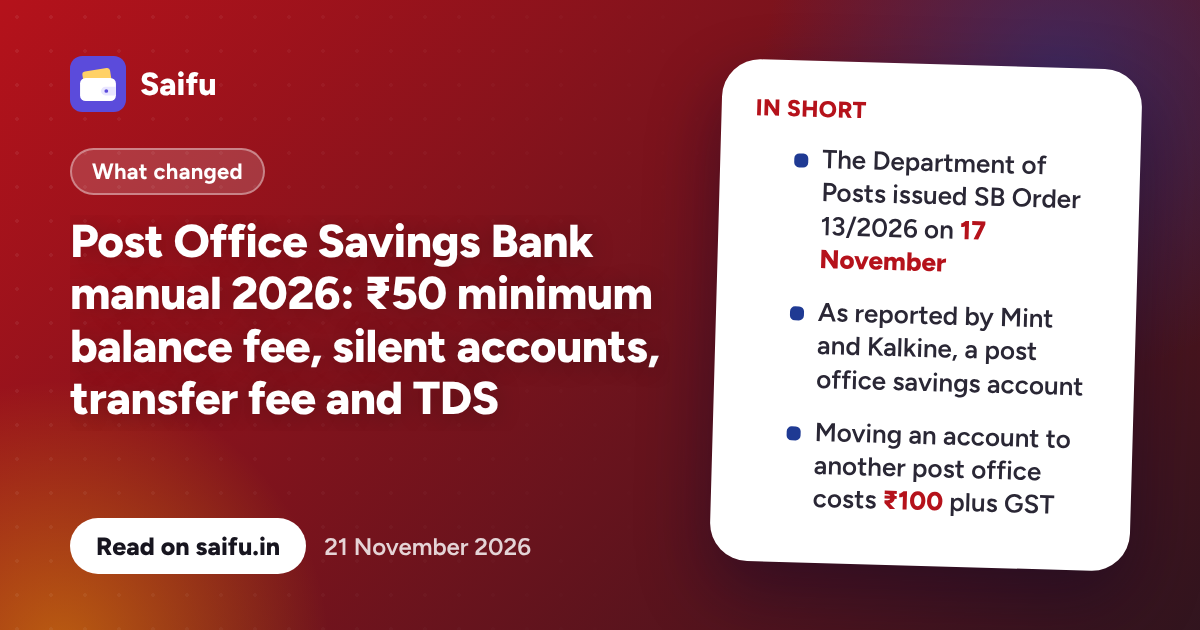
Post Office Savings Bank manual 2026: ₹50 minimum balance fee, silent accounts, transfer fee and TDS
India Post issued a new POSB manual on 17 November 2026. What it says on the ₹500 minimum balance, silent accounts, transfer fee, death claims and TDS.
The Department of Posts has released a new Post Office Savings Bank (POSB) Core Banking Solution manual. It was circulated to all postal circles under SB Order No. 13/2026 dated 17 November 2026, and it replaces the edition of 19 February 2022. The order says the manual has been updated with instructions issued up to 31 March 2026. It is mainly a rulebook for post office staff, so most of it consolidates rules that already applied. News reports on 20 November picked out six points that matter to depositors.
The order itself is only a covering letter. The figures below come from reports on the manual by Mint, Economic Times (Hindi) and Kalkine, which agree with each other. We could not read the manual text itself, so check the amounts with your post office before you rely on them.
The six points reported
Minimum balance. A savings account needs a ₹500 balance. If it is not kept, a fee of ₹50 a year applies, and this already includes 18% GST. Reports say the account closes automatically if the balance reaches zero.
Silent accounts. An account with no deposit or withdrawal for three complete financial years is treated as silent. Interest credited to the account does not count as a transaction, so interest alone will not keep it active. To revive a silent account you need to complete the post office's process, usually a KYC check and a request at the branch.
Transfer fee. Moving a savings account from one post office to another costs ₹100 plus GST.
Death claims. If a nominee is registered, the balance can be paid to the nominee with no limit on the amount and without a succession certificate. If there is no nominee, claims up to ₹5 lakh can be settled without a succession certificate. This is a good reason to add a nominee to every account.
Five-year time deposit. A 5-year post office time deposit opened on or after 10 November 2023 can be closed before maturity only after 4 years. This rule is not new. The manual restates it.
TDS on cash withdrawals. Section 194N applies to cash taken out of a post office account. For people who file their returns on time, 2% TDS applies on cash withdrawals above ₹1 crore in a financial year. For people who have not filed returns, 2% applies on withdrawals above ₹20 lakh up to ₹1 crore, and 5% above ₹1 crore. TDS is not an extra tax. You can adjust it against your tax when you file your ITR.
What did not change
The manual does not set interest rates. The Finance Ministry announces small savings rates every quarter, and the manual only covers instructions up to 31 March 2026. Check the latest notification for the rate on your scheme. Our guide on how to claim unclaimed deposits explains what to do if an old account has gone silent.
What you can do now
Look at your passbook or India Post app and confirm the balance is at least ₹500. Add or update a nominee. If you have an account you no longer use, either make a deposit or withdrawal this financial year or close it. Keep your PAN and mobile number updated at the branch.
Sources: Department of Posts: SB Order No. 13/2026, Circulation of POSB CBS Manual 2026, 17 November 2026, Mint: Post Office Savings Bank rules, 6 key changes in 2026 manual, 20 November 2026, Kalkine: Post office issues new savings rulebook after four years, 20 November 2026, Economic Times Hindi: Post office saving account new rules, 20 November 2026
Rules, rates and limits change. Check the official source linked above before you rely on a figure here. Posts never contain referral or affiliate links from the writer.
Want to write for Saifu? Here is how.