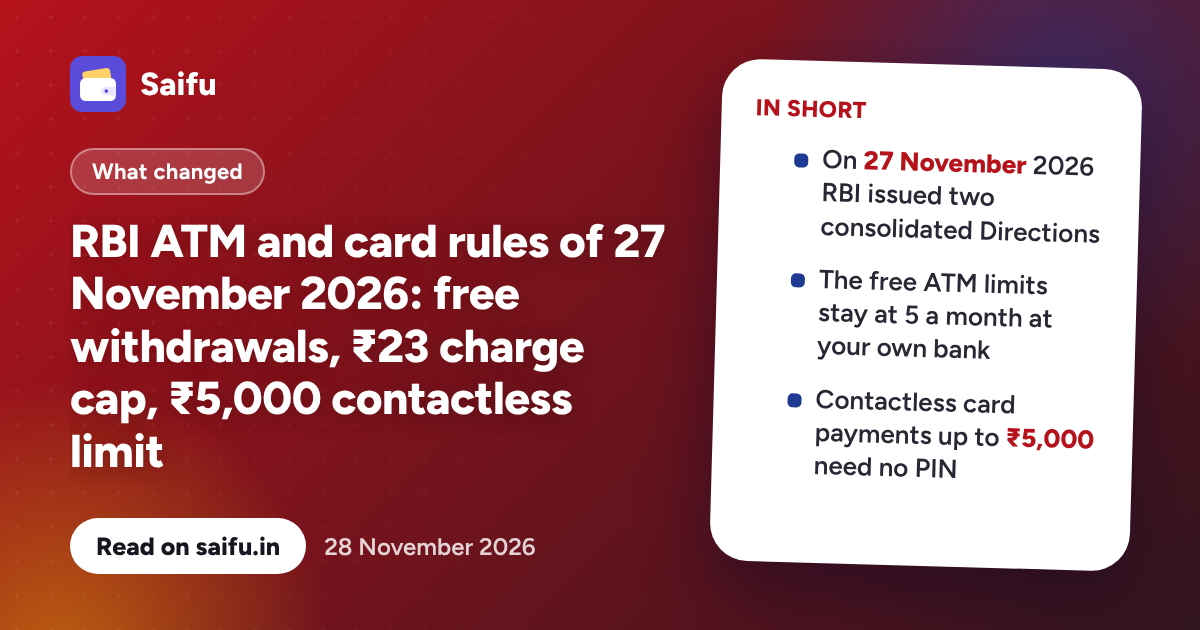
RBI ATM and card rules of 27 November 2026: free withdrawals, ₹23 charge cap, ₹5,000 contactless limit
RBI merged 17 ATM and 25 card circulars into two Directions on 27 November 2026. Free ATM use, the ₹23 charge cap, contactless and tokens explained.
On 27 November 2026 the Reserve Bank of India (RBI) put its rules on ATM cash withdrawals and on card payments into two single documents. Most of what they say already applied. The change is that you can now read each rule in one place, and RBI has repealed the old circulars. Both Directions took effect on 27 November 2026.
Mint reported that the card Directions do not announce a new limit, authentication step or card facility. This guide lists what the two documents say today.
ATM and PoS cash withdrawals
The Directions are called the Reserve Bank of India (Cash Withdrawal Transactions through Automated Teller Machines and Point of Sale Terminals) Directions, 2026. They replace 17 earlier circulars, as reported by Moneycontrol.
- Free transactions at your own bank's ATMs: five a month, counting both money and non-money transactions such as a balance check.
- Free transactions at other banks' ATMs: three a month in the metro centres (Mumbai, New Delhi, Chennai, Kolkata, Bengaluru and Hyderabad) and five a month elsewhere. If you use ATMs in both, the total free limit stays at five.
- Charge after the free limit: your bank sets it in a Board-approved policy, but it cannot be more than ₹23 per transaction plus taxes.
- Limit at another bank's ATM: ₹10,000 per transaction.
- Failed transactions: a transaction that fails for a technical reason, such as a hardware, software or communication fault or no cash in the machine, does not count as one of your free transactions, and no charge can be levied. An invalid PIN is also listed as not counting.
- Alerts: banks must warn you how many free transactions you have used in the month and what the next ones will cost.
- Metro or non-metro: each ATM must show whether it is in a metro or non-metro location, so you know how many free transactions apply.
- Cash at shops (PoS): up to ₹2,000 a transaction and ₹10,000 a month, through a debit card, a full-KYC prepaid instrument or UPI. The charge cannot be more than 1% of the amount.
- Cardless cash: banks and ATM networks may offer UPI-based cash withdrawal, with the same limits as normal ATM withdrawals.
Your bank can give you more free transactions than this, but not fewer. Basic savings accounts follow RBI's separate rules for that account type.
Card payments
The Reserve Bank of India (Digital Payments - Card-based transaction) Directions, 2026 replace 25 earlier circulars on debit, credit and prepaid cards.
- Contactless: you can tap and pay up to ₹5,000 a transaction without a PIN. Above that, the payment must be a contact payment with authentication. You can always choose to use your PIN, whatever the amount. Banks may let you set a lower limit.
- New and reissued cards: they start with use only at ATMs and shop terminals in India that read the chip. You switch on online, international and contactless use yourself.
- Card controls: you must be able to switch each type of use on or off and set limits, at any time, through the mobile app, net banking, ATM or IVR, and you get an alert when the status changes.
- Choice of card network: card issuers cannot stop themselves from using other networks, and must offer eligible customers a choice at issue, or at the next renewal for existing cardholders. This does not apply to issuers with 10 lakh or fewer active cards or to issuers that run their own network.
- Tokens: tokenising your card needs your consent with an extra authentication step. Business Standard reported that cardholders must give explicit consent again to link a renewed or replacement card to merchants where the old card was tokenised, and that consent cannot come from a pre-ticked box. You can register or deregister a card for contactless, QR and in-app use and set per-transaction and daily limits on tokens. Token services cannot be charged for.
- Card details at merchants: only the card issuer and the card network may store full card details for online payments. Others may keep only the last four digits and the issuer's name.
- Debit card charges on shops: the merchant fee is capped at 0.40% for shops with turnover up to ₹20 lakh and 0.90% for others, and 0.30% and 0.80% for card QR payments, with maximums of ₹200 and ₹1,000 a transaction. Shops should not pass this fee on to you.
What to do
- Check your bank's ATM charge. It may be lower than ₹23, but it cannot be higher.
- Open your card app and check which uses are switched on. Switch off international and online use if you do not need them.
- If a renewed card stops working for a saved subscription, you may have to link it again and give consent.
Sources: RBI: Digital Payments (Card-based transaction) Directions, 2026, RBI: Cash Withdrawal Transactions through ATMs and PoS Terminals Directions, 2026, Mint: RBI consolidates 25 card payment circulars, Business Standard: RBI for customer consent on cards, Moneycontrol: RBI consolidates ATM, PoS cash withdrawal rules
Rules, rates and limits change. Check the official source linked above before you rely on a figure here. Posts never contain referral or affiliate links from the writer.
Want to write for Saifu? Here is how.