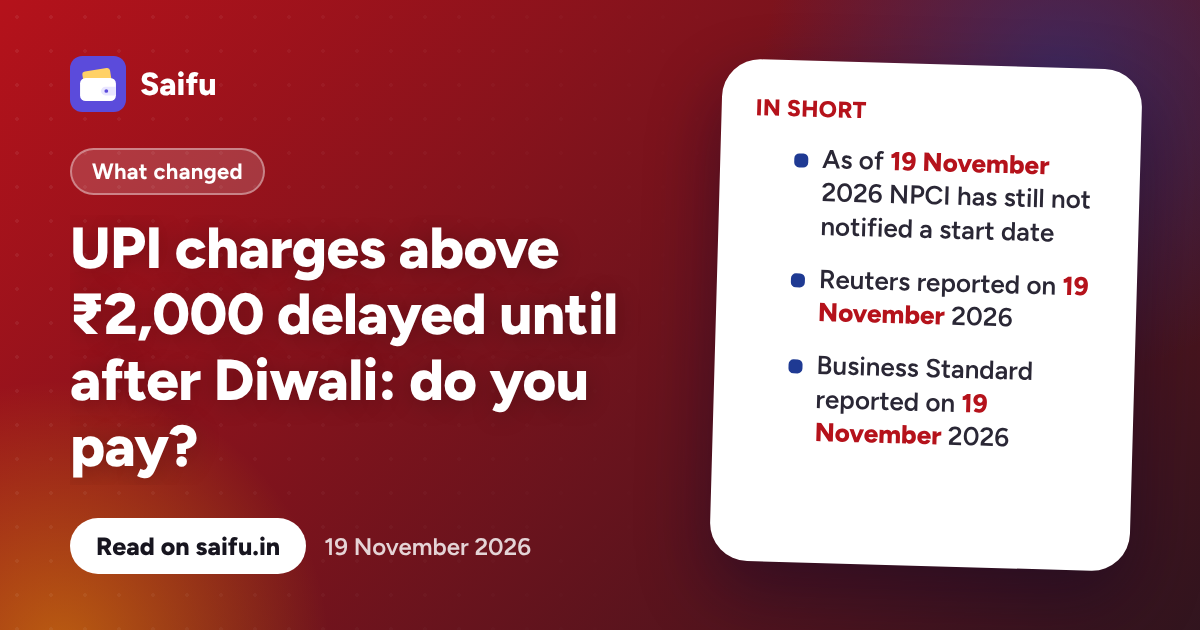
UPI charges above ₹2,000 delayed until after Diwali: do you pay?
NPCI has put off the 0.4% merchant fee on UPI payments above ₹2,000, due on 15 October 2026, until after Diwali. Customers pay nothing either way.
Shops and businesses will soon pay a fee, called the merchant discount rate or MDR, on some UPI payments they receive. It was due to start on 15 October 2026. The headlines about "UPI charges" have worried a lot of people. Here is who pays what, and when.
Update, 19 November 2026 (later): Reuters says the start date is still undecided
Reuters reported on 19 November 2026, citing three people familiar with the talks, that a final decision on the start date has not been taken. It is likely to be made with the central bank and the government. The sources said a further delay cannot be ruled out. CNBC-TV18 also reported on 19 November, citing sources, that there is no agreement yet on when the revised fee structure should begin.
NPCI and the finance ministry did not immediately reply to Reuters, so this is a report from unnamed sources and not an official notice. The 0.4% fee on merchant payments above ₹2,000 was announced in September 2026. Customers still pay nothing.
Update, 19 November 2026: a flat ₹5 fee reported for payments between merchants
Business Standard reported on 19 November 2026, citing two people aware of the matter, that UPI payments from one merchant to another will carry a flat fee of ₹5 under the new framework. These are payments such as wholesaler to retailer, business-to-business marketplaces and B2B collections. Traders had feared a fee of up to ₹300. The report says the decision was taken by NPCI's UPI and Services Steering Committee.
The September framework did not give a separate rate for merchant-to-merchant payments. At 0.4%, a typical payment of ₹20,000 to ₹40,000 would have cost the receiving merchant ₹80 to ₹160, and a payment of ₹75,000 or more would have hit the ₹300 cap. NPCI did not reply to Business Standard and has not published this rate, so treat it as a report, not a notified rule.
The start date is still not final. The Economic Times reported on 18 November 2026 that the Payments Council of India has asked the finance ministry and NPCI to announce a firm date. A distributors' body has also asked the Finance Minister to exempt merchant-to-merchant payments. Customers still pay nothing.
Update, 12 November 2026: still no date, NPCI notifies a small-merchant scheme
When we checked on 12 November 2026 we could not find an NPCI notice with the start date or the final fee notification. CNBC-TV18 reported on 12 November that an NPCI circular dated 11 November sets up a "UPI Vyapaar Saksham Scheme" to help small merchants accept UPI, paid for out of the fee money once the fee starts. We have not seen the circular, so this comes from CNBC-TV18's report.
As reported, banks and UPI apps will put 5% of their share of the fee into a fund for QR codes, soundboxes and incentives. It covers merchants with a turnover of up to ₹40 lakh and only payments of ₹2,000 or less, and it runs for three years from the day the fee starts. The circular gives no start date and no fee rates. Customers still pay nothing.
Update, 9 November 2026: Diwali is over, no start date yet
Diwali fell on 8 November 2026. NPCI's last official statement, on 13 October 2026, said the fee on select person-to-merchant UPI payments will start "immediately post Diwali" on a date to be notified separately. When we checked on the morning of 9 November, we could not find an NPCI notice with the date. Traders' bodies CAIT and AIMRA have asked for a start on 1 January 2027, as ABP Live reported on 9 November, but that is their demand, not a decision. Customers still pay nothing.
Update, 5 November 2026: NPCI's reply in the Supreme Court
In a counter affidavit filed on 3 November 2026, reported on 5 November by LiveLaw and The Hindu, NPCI told the Supreme Court that merchants are barred from passing the UPI fee on to customers, and that UPI apps cannot charge platform fees or any other charge for UPI payments. NPCI said an app that breaks this rule can face action, including losing its UPI membership.
NPCI also said the fee applies only to about 4% of person-to-merchant payments, those above ₹2,000, so about 96% of merchant payments stay free. Sending money to another person stays free for any amount, and so do small merchants receiving up to ₹1 lakh a month. NPCI repeated that the start has been postponed, and no new date has been given. These are NPCI's statements in court, and the case is still pending.
Update, 13 October 2026: delayed until after Diwali
On 13 October 2026, two days before the planned start, NPCI said its UPI and Services Steering Committee had decided, "keeping in mind the festive season", that the MDR on select person-to-merchant UPI payments "shall be implemented immediately post Diwali on a date to be notified separately", as reported by Business Standard and PTI. So no merchant fee starts on 15 October 2026.
NPCI did not give the new date. A source told Business Standard that the fee structure itself will not change. Traders' bodies and payment companies had asked for more time because of the festive season, and Reuters had reported on 8 October 2026 that a delay to January 2027 was being considered. We will update this guide when NPCI announces the new date.
Customers pay nothing
When the fee starts, it is charged to the merchant. Merchants are not allowed to pass it on to you, and UPI apps may not add platform fees. If a shop asks for extra money for paying by UPI, that is against the rules.
What is charged
- 0.4% on person-to-merchant UPI payments above ₹2,000, capped at ₹300 a payment. The cap is reached at ₹75,000.
- Railways, telecom, insurance, fuel and utility bills: a flat ₹5 a payment.
- Mutual funds and broking: 0.02%, capped at ₹300.
What stays free
- Every payment of ₹2,000 or less.
- Sending money to another person.
- Small merchants receiving up to ₹1 lakh a month through a QR code.
RuPay credit cards and credit lines on UPI
Payments from a RuPay credit card linked to UPI, or from a pre-sanctioned credit line on UPI, are outside this 0.4% fee. They follow the charges for the credit product, as card payments always have. Your card's rewards and terms do not change because of this rule.
The court case
On 28 September 2026 the Supreme Court refused to stay the fee and asked the Centre, RBI and NPCI to reply within four weeks. So the court has not stopped it, but the case could still change it. The delay announced on 13 October 2026 is NPCI's own decision, not a court order.
What might change for you
Some merchants may nudge you towards payments under ₹2,000, or towards cards, for large bills. Prices should not change. If you see a UPI surcharge, you can complain to your UPI app and the merchant's bank.
Sources: The Hindu BusinessLine (Reuters): Paytm, Pine Labs and other payment stocks fall as UPI fee rollout faces delay, 19 November 2026, CNBC-TV18: Nifty 500 movers and UPI MDR uncertainty, 19 November 2026, Business Standard: Flat ₹5 MDR fee likely for B2B UPI payments against feared ₹300 charge, 19 November 2026, The Economic Times: Payment firms seek clarity on MDR rollout for select UPI transactions, 18 November 2026, CNBC-TV18: NPCI notifies UPI Vyapaar Saksham scheme, 12 November 2026, Business Standard: UPI MDR deferred until after Diwali, new date to be notified, Siasat (PTI): Govt postpones charges on UPI transactions over Rs 2,000, Business Today: UPI MDR to be implemented after Diwali, Business Standard: UPI MDR explained, SCC Online: NPCI FAQs on UPI MDR, Business Today: Supreme Court refuses stay, Outlook Business (Reuters): UPI MDR rollout likely to be postponed, LiveLaw: Merchants cannot pass on UPI charges to customers, NPCI tells Supreme Court, The Hindu: NPCI says MDR charge has been imposed to save the UPI ecosystem, NPCI: UPI MDR on select merchant transactions to be implemented post Diwali, Financial Express: UPI MDR after Diwali, when will charges start, ABP Live: UPI MDR update after Diwali.
Rules, rates and limits change. Check the official source linked above before you rely on a figure here. Last checked 19 November 2026. Posts never contain referral or affiliate links from the writer.
Want to write for Saifu? Here is how.