Central Bank of India new charges from 21 November 2026: ATM, cheque book, cash and locker
Central Bank of India revises 69 charges from 21 November 2026. New ATM, cheque book, branch cash, locker, cheque return and demat fees, old and new.
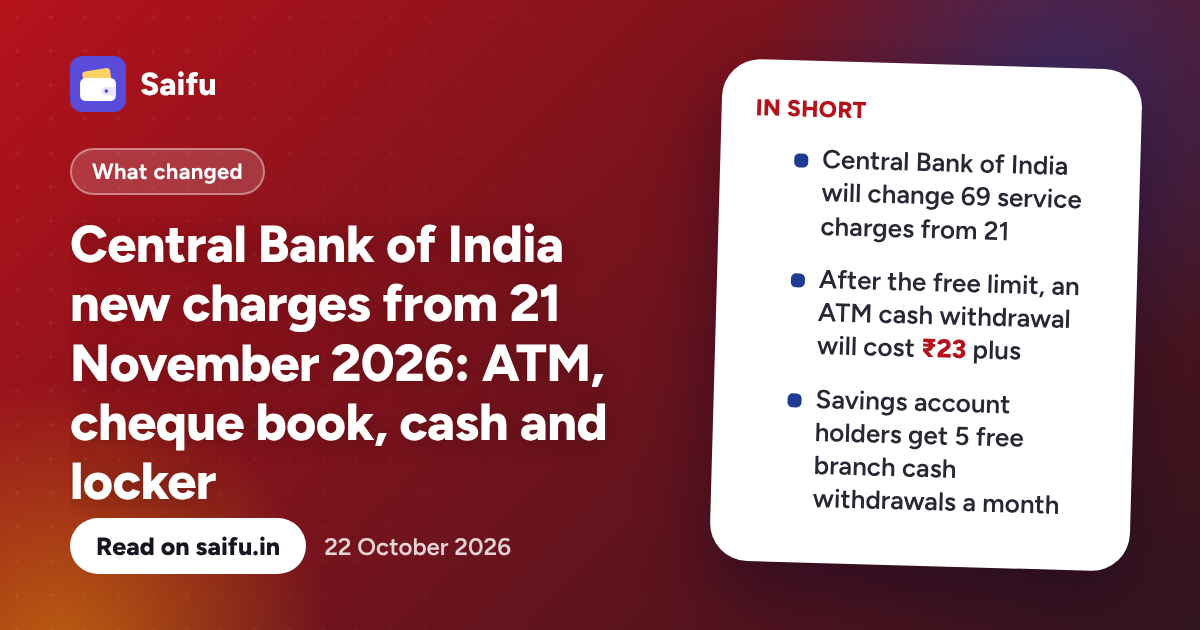
Central Bank of India, a public sector bank, will change 69 of its service charges from 21 November 2026. The list is in a notice titled "Revision of Service Charges in 69 parameters w.e.f. 21.11.2026" on the bank's service charges page. Most of the changes are increases. Here are the ones that matter for a savings account, a debit card, a locker or a demat account, with the old and the new rate.
The bank says GST is added wherever it applies, so most of these charges cost 18% more than the figure shown.
What does not change
There is still no charge for not keeping the minimum balance in a savings account. The bank's general banking page says this charge has been nil for all savings accounts since 1 July 2025, and it is not in the list of 69 changes.
ATM charges
- Your own bank's ATMs: 5 free transactions a month, cash and non-cash together, as now. After that, a cash withdrawal will cost ₹23 plus GST, up from ₹15, and a balance check or other non-cash use ₹10 plus GST, up from ₹5.
- Other banks' ATMs: 3 free transactions a month in the six big metros (Mumbai, Delhi, Kolkata, Chennai, Bengaluru and Hyderabad) and 5 elsewhere, as now. After that, a cash withdrawal will cost ₹23 plus GST, up from ₹21. A non-cash transaction stays at ₹10 plus GST.
- Bank Mitra (business correspondent) points: after 6 free cash withdrawals a month, each one will cost ₹15 plus GST, up from ₹10.
Cash at the branch
- Withdrawals from a savings account: the first 5 branch cash withdrawals in a month are free. After that you pay ₹50 for each one. Today the charge is ₹2 per ₹1,000, at least ₹25. ATM and digital transactions do not count towards these 5.
- Deposits into a savings account: up to ₹2 lakh a day is free. Above that, the charge goes up from ₹1 to ₹1.50 per ₹1,000, at least ₹25 and at most ₹10,000. You still get 5 free deposits a month, then ₹25 each.
- Current accounts: cash deposits are free only up to ₹1 lakh a day instead of ₹2 lakh. Between ₹1 lakh and ₹2 lakh a day you pay ₹100, and above ₹2 lakh ₹1.50 per ₹1,000, at most ₹30,000.
Cheques and drafts
- Cheque book (savings): 20 free leaves a year for a regular savings account, as now. After that every leaf costs ₹5. Today it is ₹3 a leaf if you order online and ₹4 at the branch.
- Cheque bounced for lack of money in your account: ₹250 for a cheque up to ₹1 lakh, up from ₹200. It is ₹500 from ₹1 lakh to ₹10 lakh, ₹1,500 from ₹10 lakh to ₹1 crore and ₹2,500 above ₹1 crore.
- A cheque you deposit that comes back unpaid: ₹150 up to ₹1 lakh, up from ₹100, and ₹400 to ₹1,250 for bigger amounts.
- Stop payment on a savings account cheque: still ₹100 for one cheque. For a range of cheques it is ₹500 for up to 10 and ₹1,000 for more than 10. Cancelling a stop payment will cost ₹100 a cheque.
- Demand draft: up to ₹10,000 stays ₹50. Above that, ₹5 per ₹1,000 instead of ₹4, at most ₹15,000. Revalidating a draft goes up from ₹100 to ₹150.
Accounts, lockers and mandates
- Closing a savings account between 14 days and 12 months after opening it: ₹500, up from ₹300. Closing it within 14 days or after a year stays free.
- Savings account entries: ₹2 for each debit entry beyond 30 in a half-year, down from 40 free entries.
- Locker registration (one time): ₹400 in rural and semi-urban branches, up from ₹300, and ₹600 in urban and metro branches, up from ₹500.
- Standing instruction to another bank: ₹100, up from ₹50. Within the bank it stays free.
- NACH mandate registration (for EMIs, SIPs and other auto debits): ₹150 a mandate. An e-mandate is free.
- NACH bounce for lack of money: ₹100 up to ₹1 lakh, as now, but ₹250 from ₹1 lakh to ₹10 lakh and ₹500 above that.
- IMPS through mobile or net banking: ₹15 for ₹1 lakh to ₹2 lakh, up from ₹10. Smaller amounts cost the same as now.
Demat accounts and loans
- Demat yearly charge (individuals): ₹500 a year, up from ₹300, unless you are a wealth customer of the bank, who stays at ₹300.
- Two-wheeler loan processing fee: still 0.50% of the loan, but the maximum goes up from ₹2,000 to ₹5,000.
- Education loan in India: processing stays free up to ₹20 lakh. Above that it will be a flat ₹10,000, except for staff, the PM Vidyalaxmi scheme and AAA or AA category colleges.
- Home loan documentation: a slab replaces the flat ₹1,350: nil up to ₹2 lakh, ₹2,000 up to ₹25 lakh, ₹5,000 up to ₹1 crore and ₹10,000 above that. The bank says the ₹1,350 charge and its processing fee waiver continue until 31 December 2026 under its festival offer.
- Gold loan kept after the loan ends: safekeeping costs ₹150 a month plus GST for loans above ₹25,000 and up to ₹5 lakh, up from ₹100, and ₹300 above ₹5 lakh, up from ₹200.
What you can do
Count how often you use other banks' ATMs and withdraw cash at the branch. Moving some of it to UPI, your own bank's ATM or the free limits can save you most of these charges. If your EMI or SIP auto debit bounces even once, the new NACH charge plus the lender's own fee can add up, so keep enough money in the account before the debit date.
The full list, including charges for business loans, letters of credit and forex, is in the bank's notice.
Sources: Central Bank of India: Revision of Service Charges in 69 parameters w.e.f. 21.11.2026, Central Bank of India: Service charges, Central Bank of India: General banking charges, Central Bank of India: Debit card charges.
Rules, rates and limits change. Check the official source linked above before you rely on a figure here. Posts never contain referral or affiliate links from the writer.
Want to write for Saifu? Here is how.