8th Pay Commission after one year: fitment factor, pay and pension revision, and when it may come
The 8th Pay Commission turned one on 3 November 2026 with no report yet. What is confirmed, what is not, and the 18-month deadline.
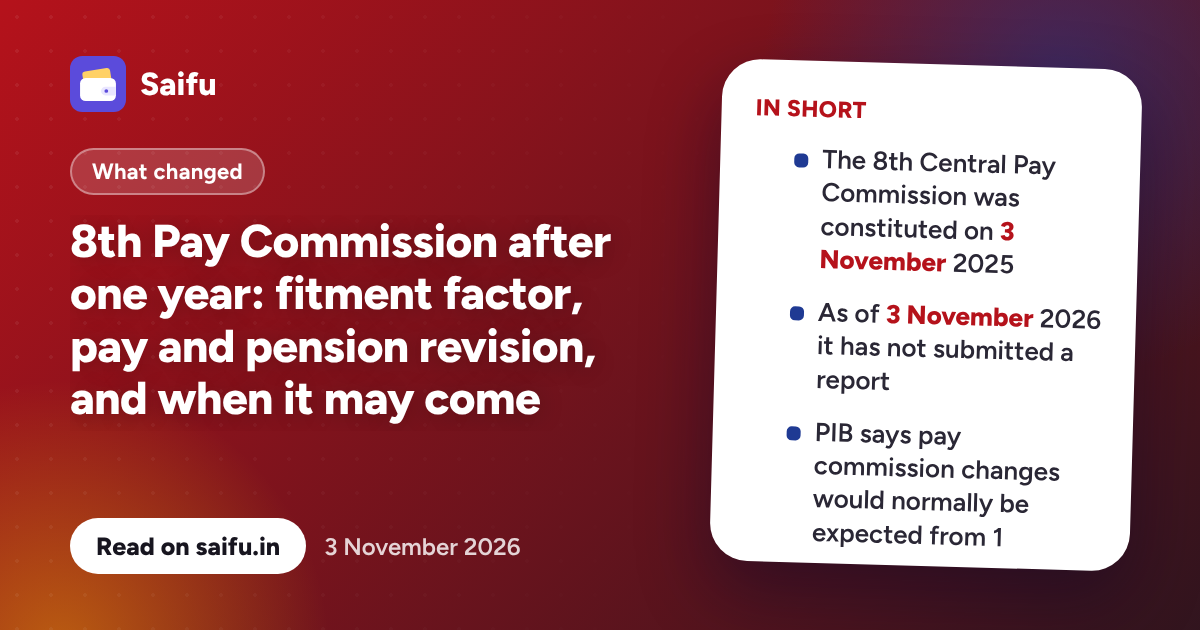
The 8th Central Pay Commission completed one year on 3 November 2026. It has not yet sent its recommendations to the government, so there is no new basic pay, fitment factor or pension formula yet. Here is what is confirmed and what is still open.
What is confirmed
The Union Cabinet approved the Terms of Reference on 28 October 2025, as the PIB release of that date says. The Commission is a temporary body with one chairperson, one part-time member and one member-secretary. It must make its recommendations within 18 months of its constitution, and it may send interim reports on any matter once those recommendations are ready.
The Commission was constituted by a notification dated 3 November 2025, which is also the date on its Terms of Reference on the 8cpc.gov.in website. Eighteen months from that date is about 3 May 2027, so the full report is not due before then.
What is not decided
The government has not announced a fitment factor, a revised minimum basic pay, a pension formula or an implementation date. On 10 August 2026 the Finance Ministry told the Lok Sabha that the Commission had not submitted its recommendations, as reported by Mint on 3 November 2026.
For comparison, the 7th Pay Commission used a fitment factor of 2.57, which took the minimum basic pay from ₹7,000 to ₹18,000. Any number you see for the 8th Pay Commission before its report is a guess or a demand, not a decision.
The 1 January 2026 date
The PIB release says that pay commissions are usually implemented after a gap of ten years, and that going by this trend the effect of the 8th Commission's recommendations "would normally be expected from 01.01.2026". That is a background remark, not an implementation order. If the government later approves a start date in the past, arrears could be paid, but the date and the arrears depend on its final notification.
What the Commission must keep in view
The Terms of Reference ask the Commission to consider the economic conditions and the need for fiscal prudence, the resources needed for development and welfare spending, the unfunded cost of non-contributory pension schemes, the likely effect on State Government finances, and the pay and benefits in central public sector undertakings and the private sector.
What it means for you now
Your pay does not change because of the 8th Pay Commission until the government accepts its report and issues orders. Until then, dearness allowance continues under the existing formula. The Cabinet raised it from 60% to 63% from 1 July 2026, as our DA hike guide explains.
Sources: PIB: Cabinet approves Terms of Reference of 8th Central Pay Commission, 28 October 2025, 8th Central Pay Commission: Terms of Reference, Mint: 8th Pay Commission completes one year, 3 November 2026
Rules, rates and limits change. Check the official source linked above before you rely on a figure here. Posts never contain referral or affiliate links from the writer.
Want to write for Saifu? Here is how.