EPS higher pension: Bombay High Court says PF trust rules cannot block it
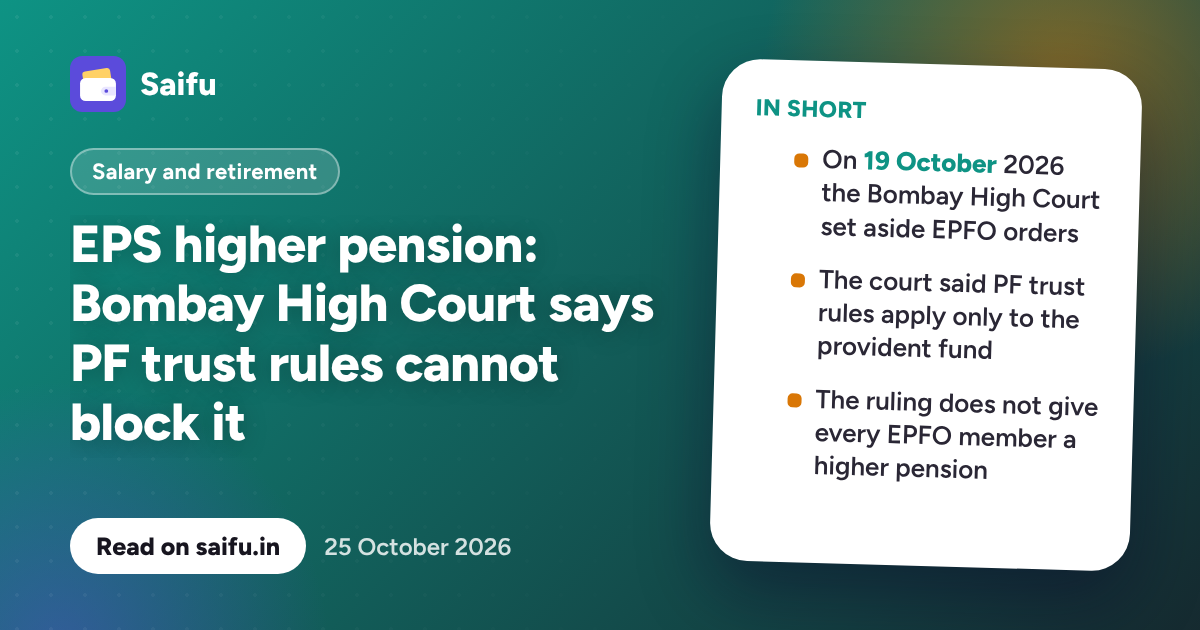
On 19 October 2026 the Bombay High Court set aside EPFO's rejection of higher pension for 40+ private sector staff of companies with their own PF trusts.
Try it: EPF calculatorWork out your EPF corpus at 58 at 8.25% interest, with the ₹25,000 wage ceiling, salary hikes, VPF and an EPS pension estimate.Private sector employees whose higher pension applications were turned down because of their company's PF trust rules have won a case in the Bombay High Court. Here is what the court decided, who it matters for, and what it does not change. The details are from the judgment as reported by Mint and The Economic Times on 23 and 24 October 2026.
What the court decided
On 19 October 2026, Justice Sandeep V. Marne of the Bombay High Court decided six petitions together. They were filed by more than 40 employees of companies such as Abbott India, Tata Communications, Raymond Steel and BEST Undertaking.
These employees had applied, with their employers, for a pension on their actual salary instead of the wage ceiling. This is called the joint option. EPFO rejected the applications because their companies run their own provident fund trusts, and the trust rules either capped contributions at the wage ceiling or did not allow higher pension contributions.
The court set aside those rejection orders. It said:
- The rules of a company's PF trust apply only to the provident fund. They have no bearing on the right to a pension on higher wages under the Employees' Pension Scheme, 1995 (EPS).
- A joint option cannot be rejected because the trust rules cap the employer's contribution, because they do not provide for a joint option, or because the employer did not pay pension contribution on wages above the ceiling.
- Where old records are missing, EPFO should look at other ways to verify them, including hearing the employee, instead of rejecting the claim.
The court told EPFO to process and allow the petitioners' joint options within eight weeks of the judgment.
Why EPFO had rejected these claims
In November 2022 the Supreme Court, in the Sunil Kumar B. case, said employees who paid PF on salaries above the ceiling could opt for a higher pension, subject to the scheme's conditions. It also held that exempted establishments, which run their own PF trusts, stand on par with others.
EPFO's head office then issued a circular on 18 January 2025. It said eligibility in exempted establishments should be decided by the existing trust rules, and that trust rules amended after the Supreme Court ruling should not be considered. The Madras High Court had already set this circular aside in a case of 86 former BHEL employees. The Bombay High Court said EPFO had relied on the same circular, and that several high courts have held that trust rules cannot be used to deny the joint option.
Who this matters for
- You worked for a company that runs its own PF trust (an exempted establishment).
- Your PF was paid on your actual salary, above the ₹15,000 ceiling that applied from September 2014.
- You applied for a pension on higher wages and EPFO rejected it citing the trust rules.
The order directly covers only the employees who filed these petitions. For others in the same position, it adds to the high court rulings that say trust rules are not a valid reason to reject. If your claim was rejected on this ground, read the reason in your rejection order. You can raise the issue with your regional EPFO office through the grievance portal, or speak to a lawyer about a review or appeal. Saifu is not a law firm and this is not legal advice.
What it does not change
The ruling does not give every EPFO member a higher pension. You still need to meet the conditions of the scheme, and the extra pension contribution on your higher salary still has to be paid as EPFO's rules require. If EPFO has questions about other parts of your claim, such as which salary heads PF was paid on, those still have to be answered.
The wage ceiling rose to ₹25,000 a month from 17 September 2026. Read what the ₹25,000 PF wage ceiling means for your pension and how EPF and EPS work.
Sources: Mint: Bombay High Court rules in favour of private sector employees seeking pension on higher wages, 24 October 2026, The Economic Times: private sector employees win higher pension case in Bombay High Court, 23 October 2026, NDTV India: Bombay High Court relief on EPS-95 higher pension, 25 October 2026.
Rules, rates and limits change. Check the official source linked above before you rely on a figure here. Posts never contain referral or affiliate links from the writer.
Want to write for Saifu? Here is how.