RBI rules on bank mis-selling and consent from 1 January 2027: what changes for you
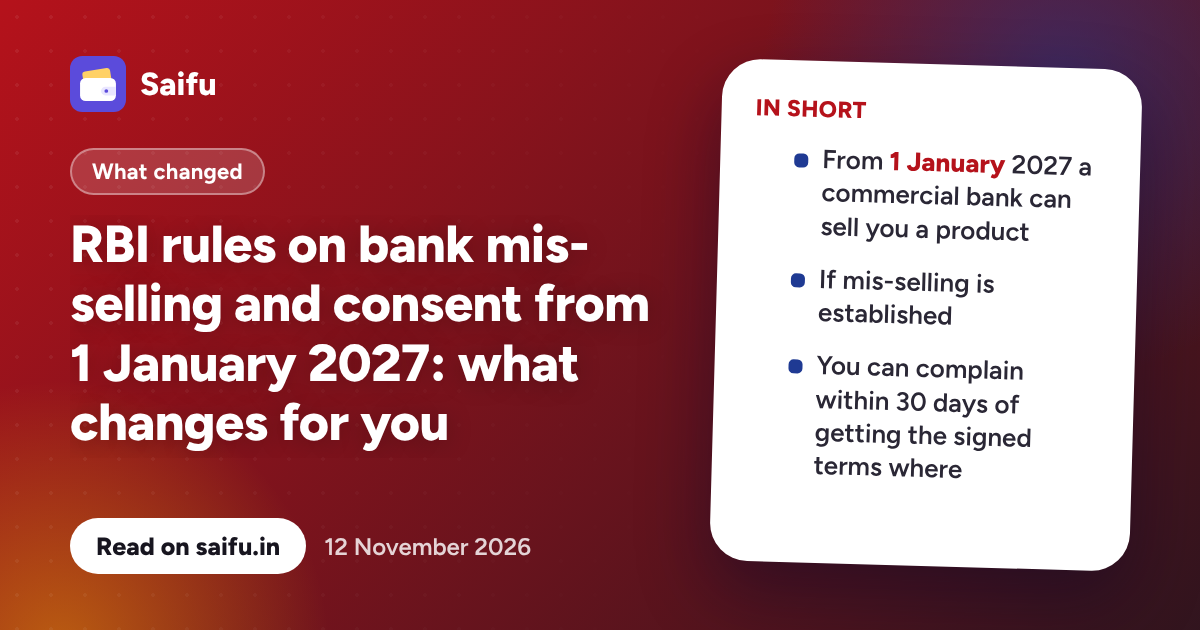
From 1 January 2027 banks need your explicit consent for each product, with the default set to No, and must refund you if a product was mis-sold.
The Reserve Bank of India (RBI) issued new rules on how banks advertise and sell financial products on 15 June 2026. They start on 1 January 2027. The rules are in the Responsible Business Conduct Second Amendment Directions, 2026 (RBI/2026-27/115). They matter for credit cards, loans, insurance sold by banks and anything else a bank sells you.
The rules were issued in June, so this is not a new announcement. We are covering them now because they start in about seven weeks and apply to the apps, forms and calls you deal with every day.
Who they cover
They apply to commercial banks, other than small finance banks, payments banks, regional rural banks and local area banks. A product sold on behalf of another company, such as an insurance policy or a mutual fund, is covered when a covered bank sells it.
What changes for you
- Consent for each product. A bank must offer a product only with your explicit consent. It can take this as a signed declaration, an OTP, a recorded confirmation, or a clearly marked section of the agreement.
- No pre-ticked boxes. If one form covers several products, each must be listed and you can choose only the ones you want. On a website or app, the default choice for consent must be "No" or "I do not agree". You cannot give consent without going through the terms.
- Fees and risks first. Before you consent, the bank must show the fees, interest rate, risks, lock-in and exit terms, including penalties. Where the RBI has a set format such as a Key Facts Statement, the bank must use it.
- No forced bundling. A bank cannot make one product conditional on buying another. It cannot pay for a product out of your loan without your explicit consent. Packages you agree to, or free extras, are allowed.
- Promotions only with consent. Promotional messages need your explicit consent, and unsubscribing must be easy. Agents should call or visit between 9 am and 7 pm unless you ask for another time.
- Papers and replies. Sale documents must be available in your regional language or a language you understand. After you apply, the bank must send an acknowledgement with a phone number. After the sale you must get a copy of the signed terms.
- Feedback. The bank must seek feedback from customers within 30 days of a sale.
Dark patterns on bank apps
The RBI lists design tricks that banks and their agents must not use. Several concern cards and accounts:
- Making a credit card easy to take but hard to cancel, with no direct cancellation link or many confirmation steps.
- Offering a lifetime free credit card without stating the spending or other condition for the fee waiver.
- Nudging you to spend more for cashback or reward points while the fine print adds conditions.
- Countdown timers or "Offer Ends Soon" messages on offers, and add-ons such as loan protection that are selected by default.
- Messages that shame you for saying no, such as "No, I don't want extra security".
If a product was mis-sold
The RBI defines mis-selling as a sale that is unsuitable for your profile, made without correct and complete information, made without your explicit consent, or tied to another product. If a bank is found to have mis-sold, it must refund the entire amount you paid, tell you the sale is cancelled where applicable, and compensate any loss as per its approved policy.
You can complain to the bank within the deadline set by the product's own regulator. Where there is none, you can complain within 30 days of receiving the signed terms.
What to do
- From 1 January 2027, read what is ticked before you tap "Continue" in a bank app. A ticked add-on is against these rules.
- Ask a bank agent for the fee and the waiver condition in writing before you take a "lifetime free" card.
- Keep the acknowledgement message and the copy of your signed terms. They start your 30-day complaint window.
Sources: RBI Responsible Business Conduct Second Amendment Directions, 2026, 15 June 2026, Hindu BusinessLine, 20 June 2026
Rules, rates and limits change. Check the official source linked above before you rely on a figure here. Posts never contain referral or affiliate links from the writer.
Want to write for Saifu? Here is how.